

Willow trees have long captured human attention with their graceful, drooping branches and resilient nature. They symbolize adaptability, healing, emotional balance, and strength across many cultures and traditions. This blend of qualities makes the willow tree a powerful symbol that connects us to themes of growth and transformation.

Understanding willow tree symbolism helps us appreciate its presence in mythology, art, and spiritual practices. We see it representing more than just beauty—its meanings touch on sorrow, protection, and rebirth, reflecting the complexities of human experience. Exploring these layers invites us to connect with the willow’s quiet wisdom and strength.
Whether in literature or cultural stories, the willow offers insight into flexibility and renewal. By examining its symbolism, we can learn how this tree inspires resilience and emotional healing in our own lives. For a deeper look into these themes, we can explore willow tree symbolism in various traditions and meanings. Learn more about its rich significance here.
Core Symbolism and Spiritual Meanings
The willow tree serves as a potent emblem of several interconnected qualities essential for navigating life’s complexities. Its symbolism spans from practical lessons in adapting to change, to deeper insights about inner strength and emotional healing. These themes resonate with our shared human experience, offering guidance rooted in nature’s wisdom.
Adaptability and Flexibility
Willows are known for their ability to bend without breaking, a trait that teaches us about flexibility in the face of adversity. Their slender branches sway easily with the wind, demonstrating that adapting to shifting circumstances often requires yielding rather than resisting.
This adaptability encourages us to remain open minded. Instead of fighting against change, we learn to flow with it, transforming challenges into opportunities. Embracing this mindset can help us maintain emotional balance, as rigidity tends to increase stress and block growth.
By observing the willow’s natural response to its environment, we gain insight into how flexibility supports survival and flourishing. It symbolizes a spirit that endures by adjusting, reminding us that strength often lies in our ability to change course gracefully.
Healing and Renewal
The willow’s presence has long been associated with healing, both physical and emotional. Its connection to water and its ability to thrive in moist soil symbolize cleansing and renewal, suggesting a process of letting go of pain and embracing recovery.
We see in the willow a natural model for emotional well-being, where healing is not an instant fix but a gradual process of renewal. The cascading branches create a serene canopy, inviting moments of reflection and calm, which are vital to restoring our spirits.
In many traditions, the willow is used to foster regeneration—whether through rituals, meditation, or simply spending time near this tree. It teaches us that healing involves patience, acceptance, and the gentle nurturing of our inner selves toward wholeness.
Resilience and Strength Through Flexibility
The willow embodies resilience not by resisting storms but by moving with them. This strength through flexibility is a profound lesson in coping with hardship, showing us that survival depends on our capacity to bend without breaking.
When life’s pressures mount, rigidity leads to fracture, but the willow’s branches demonstrate how yielding can preserve integrity under stress. This resilience is active, requiring awareness and willingness to adapt rather than passive endurance.
This symbolism encourages us to cultivate emotional resilience by embracing change and uncertainty. We strengthen our capacity to recover from difficulties by learning from the willow’s example of balanced strength, which combines softness with firmness.
Intuition and Inner Wisdom
The willow is closely linked to intuition and the deeper understanding that comes from listening within. Its roots deeply embedded in water-rich soil serve as a metaphor for connecting to hidden knowledge beneath surface awareness.
By spending time in the presence of a willow or reflecting on its qualities, we can enhance our intuitive abilities. The slow, rhythmic movement of its branches nudges us toward stillness, a vital condition for accessing inner wisdom.
This connection fosters spiritual significance, as the willow guides us toward trusting our instincts and embracing quiet insight. It reminds us that strength arises not only from external resilience but also from cultivating a deep, intuitive awareness of ourselves and the world.
For more detailed explorations, see the article on spiritual meaning of willow tree.
Emotional and Psychological Symbolism
The willow tree holds a complex place in our emotional landscape. It reflects both the depths of sorrow and the strength found in recovery. Its symbolism guides us through processes like mourning, healing, and maintaining emotional stability, revealing a profound connection to our inner experiences.
Mourning and Grief
The willow tree often stands as a symbol closely tied to mourning and grief. Its drooping branches and somber presence evoke the natural response to loss. In many cultures, this tree represents a physical expression of sorrow, reflecting the weight and tenderness that accompany bereavement.
During times of death and mourning, willows are planted near graves or bodies of water, symbolizing an outlet for tears and a bridge between life and death. Their ability to thrive near water mirrors how grief can nourish emotional growth when acknowledged. This connection helps us process loss, offering a quiet space for reflection. The willow doesn’t erase mourning but instead honors it, reminding us that sorrow is a valid and necessary part of emotional healing.
Emotional Healing
Willow trees serve as a powerful symbol of emotional healing. Their resilience in adverse environments mirrors our own capacity to recover from emotional wounds. By bending rather than breaking, willows teach us about flexibility in the face of pain.
We find that the presence of a willow can evoke calmness, making it an ideal symbol for spaces designed to nurture mental restoration. This tree symbolizes the slow but steady progress toward wholeness, encouraging us to embrace vulnerability without fear. It reminds us that healing is a process—not an instant change—and that growth often follows emotional struggle. The willow’s symbolism helps us cultivate patience and self-compassion on our healing journeys.
Emotional Balance
The willow’s adaptability symbolizes emotional balance, urging us to remain centered amidst change. Its branches sway with the wind, illustrating how we can respond to emotional turbulence without losing stability.
This balance involves accepting shifting feelings rather than resisting them. The willow shows us how to integrate opposing emotions, such as joy and sadness, into a cohesive emotional experience. Practicing this balance improves our emotional intelligence, strengthening our ability to manage stress and maintain mental well-being. In this way, the willow encourages us to stay grounded, flexible, and attentive to our inner states.
Emotional Depth
Willow trees embody emotional depth by representing a rich inner life filled with sensitivity and intuition. Their deep roots and graceful limbs symbolize connections to our past while embracing ongoing transformation.
By contemplating the willow’s quiet strength, we are reminded to explore our own hidden feelings and subconscious wisdom. This tree encourages introspection and authentic emotional expression, nurturing our ability to understand complex emotions. The willow’s symbolism supports us in honoring the multilayered nature of human experience, inspiring emotional maturity and insight through reflection.
Mythology, Folklore, and Cultural Traditions
Willow trees hold rich significance across various cultures and histories, often intertwining with mythology, spiritual beliefs, and traditional ceremonies. Their symbolism reflects resilience, healing, and connections between the physical and spiritual worlds.
Celtic Mythology and the Goddess Brigid
In Celtic mythology, the willow is sacred and closely tied to themes of flexibility and renewal. The goddess Brigid, revered for healing, fertility, and poetry, is said to have a special bond with the willow tree. Some legends describe the first willow as born from her tears, symbolizing restoration and emotional cleansing.
The willow also appears in rituals during major Celtic festivals like Beltane and Samhain, where it represents life’s cyclical nature. Its branches were used for protection, healing, and spiritual connection. This reverence extends into modern Wicca and witchcraft, where willow remains a potent symbol of feminine energy and transformation within Celtic-based practices.
Chinese Culture and the Qingming Festival
In Chinese culture, the willow tree is connected with renewal and protection. It features prominently during the Qingming Festival, a time when families honor ancestors by cleaning graves and offering rituals. People hang willow branches on doors and windows to ward off evil spirits and bring peace during this solemn occasion.
The willow’s association with water and springtime embodies rebirth and cleansing, reflecting the season’s themes during Qingming. This festival highlights the willow’s role not only in spiritual protection but also in symbolizing hope and continuity between generations.
Greek Mythology and Rituals
Ancient Greeks linked willow trees to mourning and grief. The tree’s drooping branches were seen as a symbol for sorrow and loss, often planted near gravesites or along rivers associated with the passage to the afterlife.
Certain rituals involved willow branches to honor the dead or invoke emotional healing. In myth, willow was connected to water deities and the moon, emphasizing the tree’s role in transformation and the emotional tides humans experience. The Greeks viewed the willow as a bridge between the living and the dead, embodying resilience through hardship.
Native American Beliefs and Practices
Willow trees hold healing and spiritual significance in many Native American cultures. They are often considered a source of strength and resilience, used in traditional medicine and spiritual ceremonies. The bark’s natural salicin was used to treat pain and fevers.
Spiritually, willows are believed to protect against negative energies and facilitate communication with the spirit world. Some tribes incorporated willow branches in rites to strengthen bonds with ancestors or to foster emotional balance. The willow’s connection to water also plays a key role in Native American symbolism, linking it to purification and the flow of life.
Botanical Characteristics and Types of Willow Trees
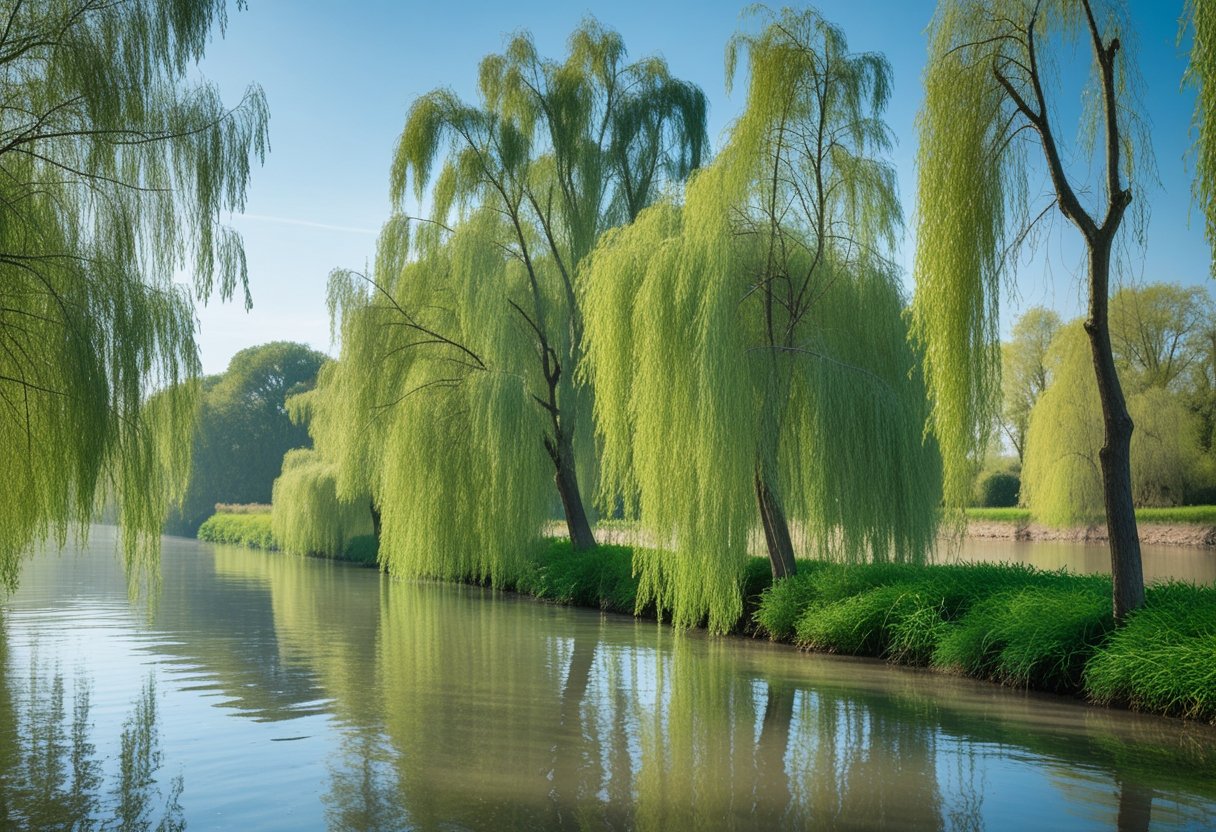
Willow trees are a diverse group with distinct traits that adapt them well to moist environments. Their forms vary widely but share common features like rapid growth and flexibility. Understanding specific types helps us appreciate their roles in ecosystems and culture.
Weeping Willow and Its Unique Traits
The Weeping Willow (Salix babylonica) is instantly recognizable by its long, sweeping branches that hang toward the ground. This graceful silhouette creates a dramatic, cascading effect, often found near ponds and lakes. Its leaves are narrow, lance-shaped, and light green, turning yellow in autumn.
Unlike many willows, the Weeping Willow’s branches are notably pliable, bending easily without breaking. This flexibility allows it to withstand wind and heavy rain. Its rapid growth rate helps it stabilize soil and prevent erosion on riverbanks.
We frequently see this species in ornamental landscaping due to its aesthetic appeal and its symbolic association with resilience and sorrow.
Black Willow and White Willow Differences
Black Willow (Salix nigra) and White Willow (Salix alba) are two prominent species with contrasting features. Black Willow grows primarily in North America and is characterized by dark brown to black bark and narrow leaves with finely serrated edges. Its branches tend to be tougher and less pendulous than the Weeping Willow.
In contrast, the White Willow, native to Europe and parts of Asia, has whitish bark and broader leaves with a silvery underside. Salix alba branches are often softer and more flexible. Both species produce catkins but vary slightly in bloom times and environmental preferences.
These willows contribute differently to ecosystems, with Black Willows often found in wetter soils and White Willows able to tolerate drier conditions near waterways.
Flexible Branches and Movement
The defining feature of willow trees is their flexibility. Their branches move fluidly with the wind rather than resisting it. This is due to strong yet pliable wood fibers and adaptable cellular structures.
This movement aids the tree in enduring storms and harsh weather without breaking. The capacity to bend also helps willows recover quickly from physical damage by continually generating new growth.
Our observation shows that this trait supports their survival near rivers where flooding or shifting soils are common. The branches’ ability to sway reduces mechanical stress and is also linked symbolically to adaptability and resilience in various cultures.
Riverbanks and Natural Habitats
Willow trees naturally thrive along riverbanks, wetlands, and other moist environments. Their root systems are extensive and fibrous, enabling them to anchor soil and reduce erosion effectively.
We find that willows prefer fresh, acidic to neutral soils saturated with water but can survive mild flooding. Their presence stabilizes banks and creates habitats for wildlife such as birds and insects.
New growth often appears easily from cut branches or fallen twigs, reflecting willows’ remarkable regenerative ability. This characteristic fosters rapid colonization in riparian zones, contributing to biodiversity and ecosystem health.
For a detailed overview of willow species and habitats, explore the information on willow tree types and uses.
Practical Uses, Healing Properties, and Influence on Art

Willow trees have played a significant role beyond their symbolic meaning, offering medicinal benefits and inspiring artistic expression. Their bark serves as a natural source of important compounds, and their flexible branches are valued in craftsmanship. We will examine the chemical properties in willow bark, traditional medical uses, representations in art and literature, and the practical applications of willow wands.
Willow Bark, Salicin, and Aspirin
Willow bark contains a key compound called salicin, which has been used for thousands of years as a natural pain reliever. Once ingested, salicin converts into salicylic acid in the body, the active ingredient that reduces inflammation and fever. This compound laid the foundation for modern aspirin, synthesized in the late 19th century as a more stable and less irritating form.
The connection between willow bark and aspirin is a cornerstone in pharmacology, demonstrating how natural substances influenced drug development. Not all willow species contain equal amounts of salicin, so traditional use required knowledge of specific varieties. This relationship between plant chemistry and medicine underscores the practical value of willow in human health.
Pain Relief and Traditional Medicine
Historically, willow bark was a staple in folk medicine across many cultures. We observe records of Assyrians, Egyptians, and Greeks using infusions of willow bark to treat conditions like pain, fever, and inflammation. It was especially common to address ailments related to the joints, such as rheumatism.
The anti-inflammatory properties made willow bark a natural remedy long before synthetic drugs existed. People also used the plant in line with sympathetic magic, believing its growth in wet areas made it effective against ailments caused by damp conditions. While modern medicine now prefers aspirin, willow bark remains an example of early herbal pharmacology with practical applications in pain relief.
Willow Trees in Art and Literature
Willow trees have been a recurring subject in Western art and literature, often symbolizing sorrow, resilience, and flexibility. Artists like Claude Monet captured the willow’s graceful branches and reflective qualities, highlighting its calming presence in landscapes.
Literature uses the willow motif to explore emotional depth and mourning, with references found in various cultural narratives. The tree’s flowing form and association with water evoke themes of renewal and sadness simultaneously. This duality makes the willow a versatile symbol that artists and writers continue to draw upon to express complex feelings and states of being.
Willow Wands and Craftsmanship
Beyond medicine and symbolism, the physical properties of willow wood have practical uses in craftsmanship. The pliable branches, or willow wands, are ideal for making items such as baskets, hurdles, and wattles. Their flexibility allows for weaving without breaking, making them a favored material in traditional crafts.
These willow wands hold cultural significance in some regions, associated with protection and good luck. They were also used historically in rituals and for household uses like supporting structures or decorations during holidays. The combination of physical usefulness and symbolic meaning makes willow branches unique tools woven into both daily life and cultural practices.
For more on the medicinal history, see willow bark and aspirin’s connection at The Metropolitan Museum of Art. Insights into its symbolism in art and literature can be found at SimpleBeyondHerbs.
Personal Growth, Transformation, and Modern Relevance
Willow trees teach us important lessons about resilience and adaptability. Their symbolism extends to themes of healing, renewal, and emotional strength that resonate deeply in today’s fast-changing world. Embracing these lessons can help us navigate personal challenges and foster meaningful transformation.
Renewal and Rebirth
Willows symbolize renewal through their natural life cycle and ability to thrive near water. Their branches often shed and regrow, reflecting a continuous process of rebirth. This cycle encourages us to let go of old limitations and embrace fresh starts.
The tree’s capacity to regenerate after storms mirrors how we can recover from setbacks. Just as willows bend without breaking, we are reminded to be flexible in the face of adversity. This natural symbolism invites us to recognize growth opportunities in disruption and change.
Feminine Energy and Spiritual Growth
The willow has long been connected to feminine energy, associated with intuition, nurturing, and emotional depth. Its flowing branches and gentle sway evoke softness paired with strength, encouraging balance between sensitivity and resilience.
Spiritually, the willow supports healing and introspection. Its presence in rituals often aids emotional release and fosters spiritual transformation. By harmonizing our inner emotional world, we create space for quiet strength and sustained growth.
Personal Growth and Embracing Change
Personal development requires openness to transformation, much like the willow’s ability to adapt to shifting environments. Its flexible branches symbolize the power of yielding without losing integrity. This teaches us that true resilience involves bending with life’s pressures rather than resisting them outright.
By internalizing the willow’s lessons, we foster patience, endurance, and emotional healing. Incorporating willow symbolism in daily life—as reminders in art or meditation—can help us focus on growth, renewal, and enduring strength through change. For more insight into these transformative meanings, explore the Willow Tree Symbolism and its modern applications.


Leave a Reply